
Recent Posts
- Why Consistent Posting Beats Viral Content for Business Growth
- Ad Fatigue Explained: Why Your Campaigns Perform Well Then Suddenly Drop
- Why Visitors Leave Your Website in Under 5 Seconds (And How to Fix It)
- SEO reporting in 2025: What Actually Matters
- Building a Scalable Online Presence in 2025: A Step-by-Step Digital Strategy Guide
Recent Comments
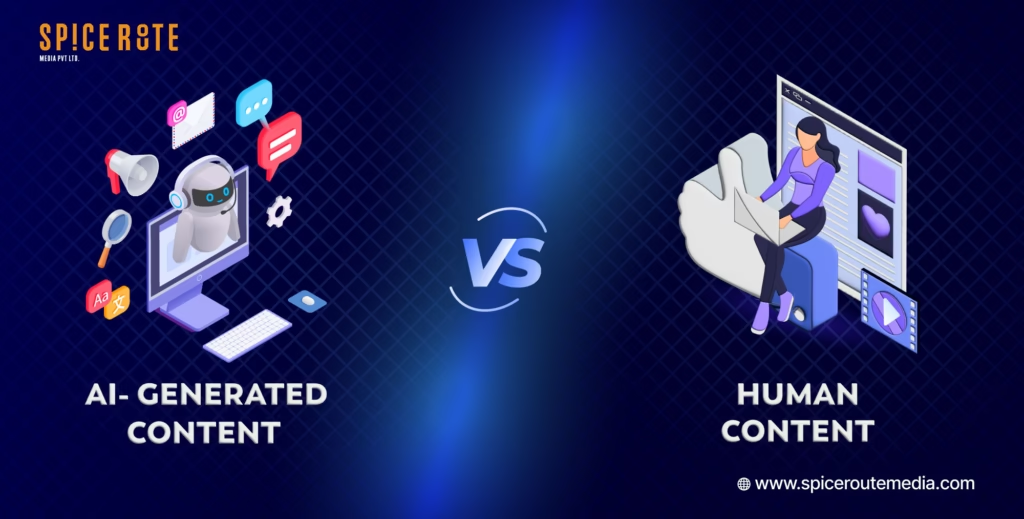
To be honest, many of us believed that traditional content creation was doomed when AI first started producing blogs, articles, and product descriptions with a single click. However, the dust has settled in 2025. What Google actually wants—AI vs Human Content—remains a significant question.
Spoiler alert: It’s not quite that clear-cut.
At SpiceRoute Media, we help you understand what google wants and how to use AI and Human Content according to your business’ need. This guide explains the importance of Human Content and AI-Generated content and what Google actually prefers and ranks.
What Google Says: AI vs Human Content
Before we deep dive into the pros and cons of AI vs Human Content, we need to understand what Google actually wants and which type of content it actually prefers.
Google has stated time and time again that it does not automatically approve content created by AI. The most important variables are originality, quality, and helpfulness.
Giving viewers the most useful, educational, and excellent content is Google’s main objective. Expertise, Authoritativeness, and E-A-T trustworthiness all come into play here. Content that aligns to these guidelines typically receives higher rankings. Therefore, the content needs to conform to Google’s strict requirements regardless of whether it was created by AI or a human.
The takeaway from this- Google doesn’t care how content is created—it only cares how well it serves the user.
This viewpoint has been simmering since the first wave of generative AI tools like ChatGPT and Jasper.ai, but it has been solidified by recent declarations, revisions to the Search Quality Rater Guidelines, and the obvious effects of the Helpful Content System. AI-generated material is not inherently devalued. However, and this is crucial, it has to stick to the same criteria as content produced by humans.
And that’s where a lot of writers fail.
AI-Generated Content: Automation's Rising
GPT-4 and other AI writing technologies are becoming more and more popular for creating product descriptions, blog entries, and other kinds of content. AI is a useful tool for companies that must meet regular content demands because it can generate content rapidly and in large quantities. AI content isn’t always flawless, though. It frequently lacks human writers’ profound comprehension, inventiveness, and nuanced voice.
GPT-4 and other AI writing technologies are becoming more and more popular for creating product descriptions, blog entries, and other kinds of content. AI is a useful tool for companies that must meet regular content demands because it can generate content rapidly and in large quantities. AI content isn’t always flawless, though. It frequently lacks human writers’ profound comprehension, inventiveness, and nuanced voice.
Human Content: The Authentic Touch
Yet because it has been created with skill, compassion, and a human touch, human-generated content frequently has a clear benefit. Content that feels genuine and has genuine value is typically given priority by Google. The overall quality of the text is improved by human writers’ ability to conduct in-depth research, comprehend user intent better, and provide nuanced viewpoints. Google favours material that directly responds to user inquiries and offers insightful information.
Additionally, human content excels when it incorporates unique findings, first-hand accounts, or in-depth analysis that AI systems find difficult to duplicate.
The Role of E-E-A-T in Ranking Decisions of AI vs Human Content
Google’s E-E-A-T model—Expertise, Experience, Authoritativeness, and Trustworthiness—is directly affected by all of this. Google uses it as a guide to determine how effectively a piece of material meets the needs and expectations of actual users.
- Experience: Examples and experiences from real life
- Expertise: Understanding of the topic
- Authoritativeness: Recognition within your sector or specialty
- Trustworthiness: Precision, openness, and dependability
Although AI can produce content fast, it struggles to demonstrate trust and experience. Human writers and editors excel in this situation by incorporating first-hand accounts, knowledgeable analysis, and reliable sources.
AI, for example, can create a good financial budgeting how-to. However, the advice may be out of date, deceptive, or just too general to be useful without the expert’s eye. Google doesn’t want users to see that, and it won’t rank as well.
The Statistics: AI vs Human Content
Let’s discuss data.
Human-generated content surpasses AI in terms of user engagement by about 47%, according to recent performance data from systems like Junia AI and Textuar. That separation is a chasm, not a small one.
Why? For several reasons:
Authenticity strikes a chord: Users can frequently tell when a human voice is speaking behind the screen, when a narrative is based on personal experience, or when a nuanced viewpoint is presented.
Engagement remains high because human-written content typically lowers bounce rates and keeps readers on the page for longer—two important ranking indicators.
Trust is still important: Readers seek out reputable authorship, particularly in the fields of finance, health, and law. Personal perspectives, credentials, and biographies are very helpful.
Users still trust information that feels “lived-in,” even when AI is quick. It’s similar to choose between a knowledgeable person who has been there and done that and a pre-recorded helpdesk robot; you’ll probably choose the human every time.
Top Techniques for AI-Generated Content in 2025
A visual reference to 2025 SEO success—checking all the boxes with AI-assisted content by adhering to best practices based on human monitoring and quality.
A visual reference to 2025 SEO success—checking all the boxes with AI-assisted content by adhering to best practices based on human monitoring and quality.
What works in 2025 is as follows:
- Integrate Human Editing with AI Efficiency
AI can be used to plan, write, or recommend structure, but a human editor must always review the finished result. Fact-checking, adding personality, and polishing tone are essential.
- Set priorities E-E-A-T
Your writing should have the appearance and feel of having been authored by an expert in the field. This could be identifying pertinent experience, referencing industry data, or providing a link to your credentials.
- Provide Distinctive Value
Steer clear of the echo chamber. Don’t merely summarize Google’s documentation when developing an SEO guide for 2025; instead, include your own case studies, viewpoints, or practical advice.
- Be Open About the Use of AI
Transparency builds trust, but you don’t need to post a neon sign that reads, “This was written by AI.” It’s as easy as saying, “This article was created with the assistance of AI and reviewed by [Your Name].”
Conclusion
As AI continues to reshape digital content creation, the debate between AI-generated content and human-written content will only grow stronger. However, Google’s stance in 2025 is clear: it does not reward content based on how it was created, but how helpful, accurate, and trustworthy it is. That means both AI and human content can rank — if they meet Google’s strict quality, originality, and E-E-A-T standards.
Human content continues to lead in authenticity, depth, and real-world experience, while AI excels in efficiency, scalability, and speed. The strongest results come from combining both: AI for structure and productivity, and humans for expertise, insight, and credibility.
At SpiceRoute Media, we help businesses balance AI innovation with human creativity. Our content strategies ensure every article, page, and script is optimized for Google’s evolving guidelines, supports real user needs, and reflects authentic expertise.
Contact us today to discover how we can elevate your content strategy with a smart blend of AI efficiency and human storytelling.
- No Comments